
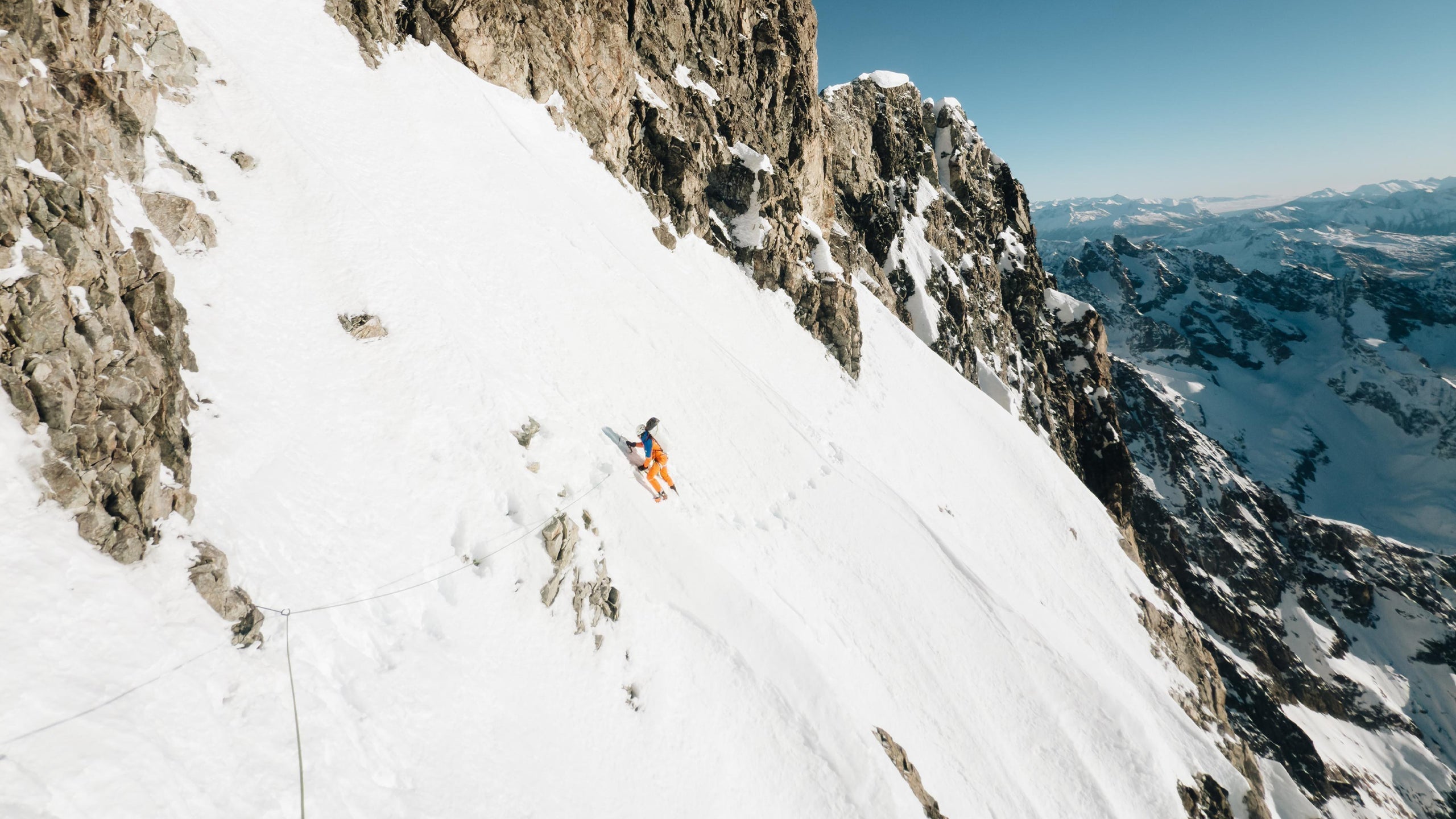
Charles Dubouloz: a solo winter trilogy
“I’m not a numbers guy: numbers are never the best way to sum up an adventure.”
That’s how French alpinist Charles Dubouloz replied when we asked him to tell us more about his solo winter trilogy.
As he did last year after his Gasherbrum IV expedition, Charles reminded us that beyond challenges designed to break records or showcase outstanding performances, there are journeys—adventures born from the desire to listen to what the mountain has to say, when you are the sole witness to your own breathing, your thoughts, and, in those rare moments when you dare to speak out loud, your own voice.
This experience tells the story of winter’s cold and solitude: a trilogy spanning the Alps and the Pyrenees, linking kilometers of asphalt ridden by bike, steep alpine faces of rock and ice, and nights spent in a tent beneath endless stars—or in the middle of a storm. It wasn’t a race against time, but a test of resilience. Endless waits, split-second decisions—for Charles, solo alpinism is less about being alone and more about confronting yourself face to face, caught between external doubts and the inner drive pushing you forward.
In this interview, we go behind the scenes of a project shaped by effort, long days spent riding and making ascents, always walking that fine line between fear and absolute focus.

Charles, congratulations on this incredible adventure! Can you share a few numbers from your journey?
“Mmm, okay, I’ll try! Even though I’m definitely not a numbers guy. For me, even if it’s important to know what I’m going to go up or how many kilometers I’ll have to cover by bike, numbers are never the best way to sum up an adventure. For example, if I told you I cycled around 140 kilometers a day this winter, you might say, ‘Yeah, that’s normal.’ But numbers don’t tell you that I was towing a trailer loaded with gear and equipment, or that the wind was often blowing straight in my face! That’s why I’m not a big fan of data. But to answer your question, here’s a rough overview:
Around 100 pitches completed during the trilogy
Around 1,800 kilometers by bike
10 nights spent bivouacking on the routes, and far too many nights spent outdoors in the wild!”
Where did you stay or wait during periods of bad weather?
“Most of the time I stayed outside in my tent, waiting for a weather window… but when I was in the Pyrenees, after three weeks of waiting, I went back to visit my family in Annecy and stayed there for three weeks before returning to attempt the Pic d’Ossau.”
Had you already done the routes of this project in easier conditions? Maybe in summer and with partners?
“Yes, I had already completed Divine Providence in summer five years ago with Christophe Dumarest… in a single push! But in winter it’s a completely different story. I had never been on the Gamma route in the Écrins massif before, while I had already attempted the northwest face of the Pic d’Ossau the previous winter, solo. That time I gave it a real try, with a lot of determination, but the conditions were not good at all and I had to turn back…”
Did you decide which routes to take on from the start, or as you went along?
“Good question. The first route, Divine Providence on Mont Blanc, was decided before I left, because for me it was important to reach the summit of Mont Blanc as the first stage of this trilogy. My preferred option was Divine, because it’s steep, hard, and committing—everything I’m looking for in the mountains! For the other two routes, I stayed flexible depending on the conditions… but my goal was still to choose serious, committing lines.”
Why take on a project like this alone rather than with a partner? What are you looking for in the solo experience?
“What I love most, actually, is sharing adventures. I have many friends I care deeply about, but sometimes I also enjoy being alone. Solo alpinism is very powerful because you have to solve every problem on your own. It’s definitely harder, but it’s an interesting path to follow. I think this way of moving in the mountains has helped me become the man I am today. That said, I believe these were my last solo ascents! I’m starting to get older, and I don’t want to push this style too far. It’s very demanding, and sometimes you end up playing with luck… and right now, I feel like I don’t want to take too many risks anymore.”

What do you feel when you’re alone on a face? Are you calm or do you feel pressure?
“I think I’m calm, but I always feel a bit stressed. I believe it’s essential to feel stress and fear, because it’s the best way to stay focused. If you don’t feel these things during a six-day ascent on a face, there’s a risk of making a fatal mistake.”
Are you planning to do something similar on rock this summer?
“No, no! I really think that what I completed this winter were my last solo pitches.”
How do you prepare for a challenge like this, both physically and logistically?
"I think the most important part of preparation is experience. You can’t start your career with a big project like this; you need to spend a lot of time in the mountains first and develop all your mountaineering skills. Before this trilogy, I did many solo ascents, step by step. Only when you feel ready do you give it a try. From a logistical point of view, the preparation took longer than usual because I had to plan the cycling part in advance. I needed a trailer and a lot of equipment that I didn’t own. It took me about a month just to find everything I needed and get everything ready.”
Did you move entirely without external support?
“I tried to carry most of the equipment myself, but it was impossible to fit everything on the bike, so in reality I wasn’t completely unsupported… except during the ascents. Once I was on the face, I was fully self-sufficient.”
What philosophy guided your project?
“I’d say I didn’t have a specific ethic. Nothing related to ecology or anything like that—just the desire and the drive to live a long outdoor adventure. That’s what I was looking for. A long journey, not just a hard ascent and then straight back home. Time mattered to me, but not in the way we usually think about it. In this case, I wanted to spend as much time as possible outside, in nature.”