


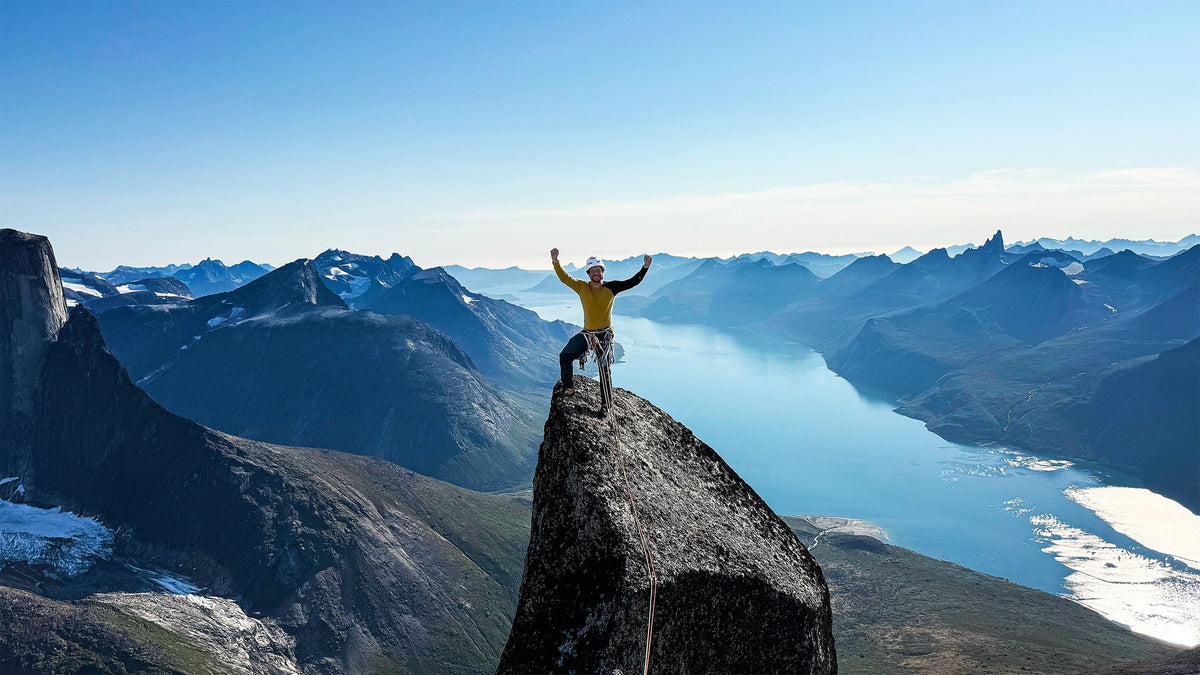
Greenland: 5 Weeks in the Fjords with Silvan Schüpbach
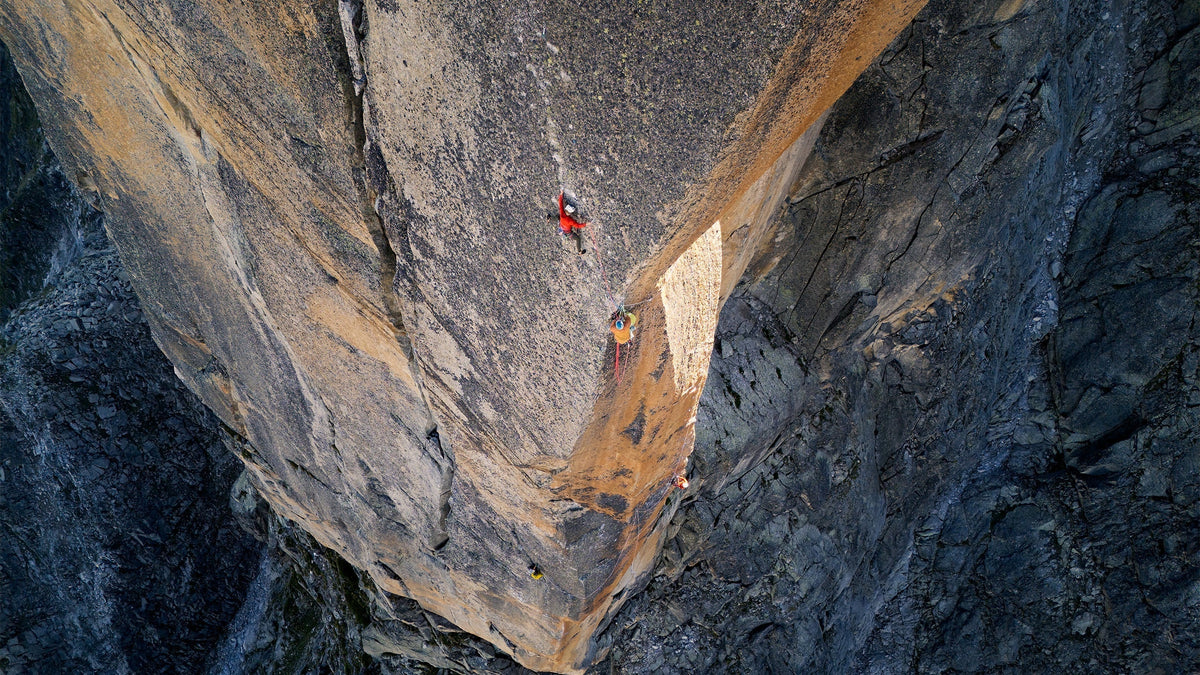
In mid-July, I teamed up with Filippo Sala, Benjamin Bosshard, Jernej Kruder and photographer Hugo Vincent to climb an unclimbed and mysterious wall deep inside the well-hidden Kangikitsoq Fjord in South Greenland. In August, I roped up with Michaela Mooz, looking for high-quality rock and moderate Lines.
We covered more than 200 km by sea in a small dinghy that we had brought all the way from Switzerland. It soon became clear, however, that climbing would not be the main challenge of this adventure. During our first few days, Benji got sick and had to return home, while rough sea conditions prevented us from even starting our journey. In Greenland, there are two bosses: the weather and the sea.
When we finally set off by boat, the locals told us, “These guys are playing with fire.” We felt a bit like tourists in the Alps attempting the Matterhorn in flip-flops. Anyway, whether you call it luck or skill, we somehow managed to reach our base camp a few days later.
When the forecast showed no sign of good weather, I remembered Jernej’s wise words: you shouldn’t believe everything that’s written on the internet. So we packed our stuff and started the approach anyway.
A 20+ km hike through bushes and swamps brought us, together with our enormous haul bags, to the base of the wall. There, we huddled together under a huge boulder, surrounded by seracs and towering rock walls. The only thing that made this miserable camp—with fog, rain and rockfall—bearable was the lack of mosquitoes and midges. Back at base camp, they had literally been eating us alive.
Eventually, we started running out of food. And when the forecast—the one written on the internet—turned out to be both pessimistic and correct, we decided to hike back to base camp without having climbed a single metre.
After a few more days, good weather finally arrived. During Jernej’s last three days before he had to leave, we managed to open a new route on the Mountain Baroness in Torsukattak Fjord.
An old sling suggested that the wall had been climbed before, so we chose a difficult-to-protect line through the centre of the face. Once we finally started climbing, everything went surprisingly smoothly. From an adventurer’s point of view, climbing in Greenland can almost be the most boring part of the expedition—there are simply fewer surprises. Still, it was anything but boring to belay Jernej on his stunning, hard slab runouts during the ascent.
In three days, we climbed “Sila”, a new route on the northwest face of the Baroness: approximately 600 m, 7c and A2+.
After Jernej left, we managed to open another new route on Marlilussat, a beautiful mountain behind the village of Aappilattooq. We climbed around 800 m in one long day, with difficulties up to 6c. The final section of the route might overlap with a line climbed by a French team during the Maewan sailing expedition.
At the beginning of August, my friends Filippo and Hugo left, and I welcomed Michaela Mooz, who fortunately brought some good and stable weather with her.
We opted for moderate, long and high-quality routes. As a warm-up, we climbed the now-classic Swiss Route on Ketil’s Pyramid in Tasermiut Fjord. We then sailed to Torsukattak Fjord, where we climbed three more routes:
The Baron – Southeast Pillar. Approx. 500 m, 6b max (mostly 5th grade). A wonderful climb on an amazing mountain—this should become a famous classic! On the col before the climb, we found an established tent platform. Higher up, we spotted an old rappel sling. I suspect the route has been climbed several times, but there are many possible variations. We descended by rappelling from our own improvised anchors, staying 50–100 m to the side of the pillar and descending through the East Face. From what we saw, this face appears to have even better rock and does not seem to be any harder than the pillar.
Campsite Hill. Approx. 400 m, 6b max. This is the most easily accessible wall in the fjord. We climbed a line offering varied climbing, from offwidth to slabs and steep, juggy sections. Pretty impressive for a wall with only a half-hour approach! The wall has seen some activity before, so we cannot say for certain whether our line was a new route or not. We descended by rappelling from our own improvised anchors.
The “Orange Wall”. This southeast-facing wall was called the “Orange Wall” by our predecessors in 2024. It forms the continuation of Campsite Hill. We climbed what is most likely a new line just to the right of the existing “Dream Corner.” Approximately 600 m, 7a max, with mostly easier climbing. The highlight was an unforgettable 60 m finger-to-hand splitter in the headwall. We descended by scrambling and walking, with two short rappels. We call this new Route “Thalassaphobia”. The Name refers to my steady fear that we could loose our boat and got stranded in the middle of nowhere.
The amount of well-structured, high-quality rock around Aappilattooq is amazing. If it weren’t for the complex logistics and unpredictable weather, this would be one of the best places for alpine climbing in the world.
Once again, Greenland has been an incredible experience. What made this trip particularly special was having our own boat, which allowed us to change locations freely and explore different areas.
Even more special was the combination of climbing with friends during the first part of the trip and then switching into the role of a guide later on. It was a great mix of adventure, exploration, friendship and work—and a perfect way to spend five weeks in Greenland.