


Sudafricana 1200m; 5.12c, Torre Central del Paine
Caro North, Amelie Kühne, Belen Prados, Julia Cassou
Months of planning between Bariloche, El Chaltén, the USA, and Europe. Messages, endless gear lists, anticipation, an idea slowly taking shape. Then finally: we meet in El Calafate. Our car is far too small for what lies ahead. Everything that doesn’t fit gets strapped to the roof. From there we continue to Puerto Natales, the last stop before the spectacular Torres del Paine, already visible from afar. At the Redpoint Hostel we settle in, spreading all our gear across the floor. For the next 20 days, it’s all about shopping, sorting, discarding, and repacking. The first haul bags are carried to the wall, the first pitches climbed.
Our goal is clear and now right in front of us: a team ascent of Torre Central del Paine in 17 days, ideally free. The excitement runs high, but so does our respect for the wall.
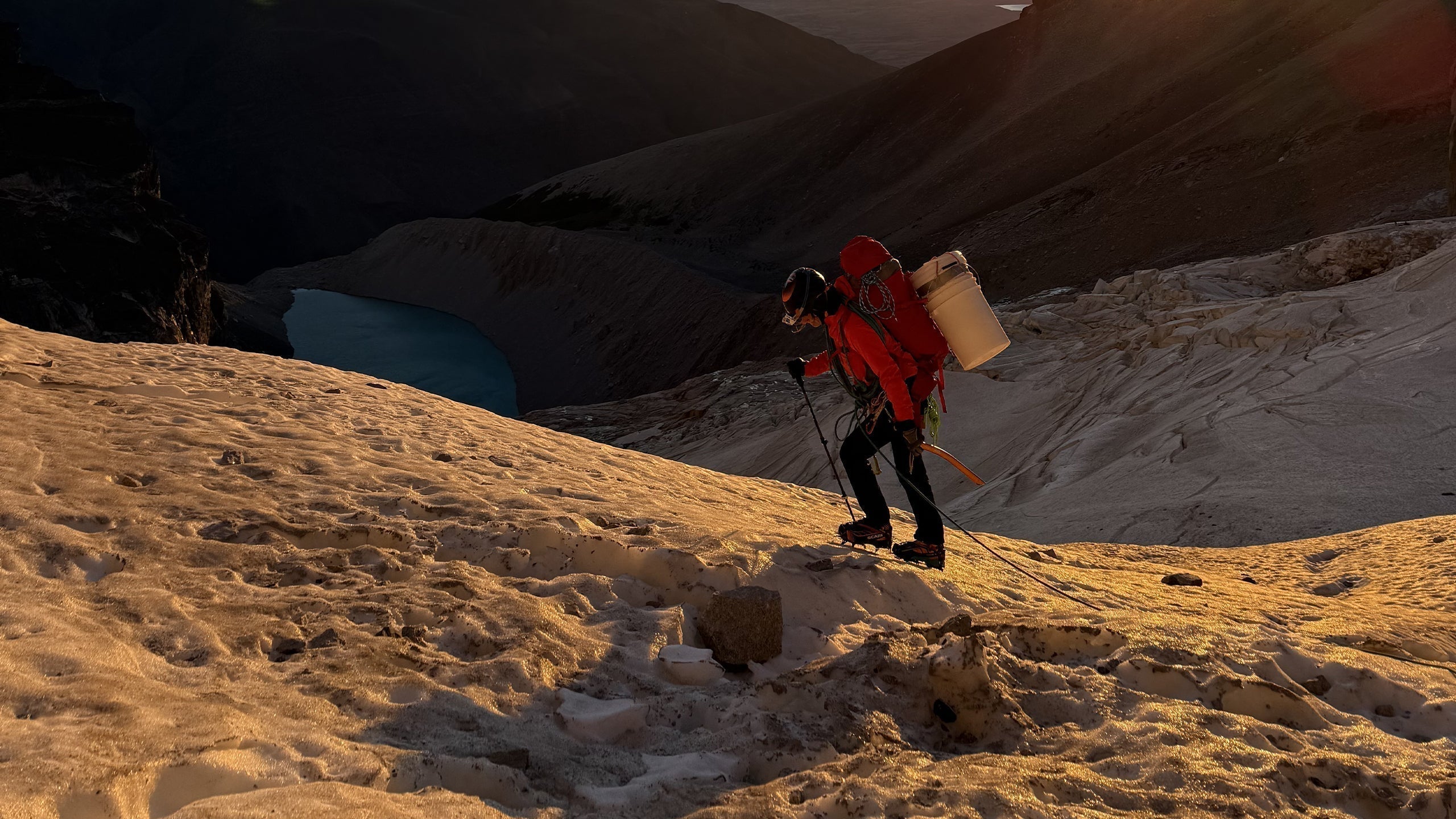
The approach: 2.5 hours to Campamento Torre, 1.5 hours to the Belgier bivouac, then another 1.5 hours across rough terrain and an exposed glacier to the base. With packs weighing up to 35 kg, every step grows heavier and more meaningful. Before committing to the wall, we fix the first pitches up to the “Shattered Pillar” (L10). A tense start: slabby climbing, rockfall, and ice pouring down from above. We get creative, placing pitons, small cams, and accepting long runouts. Progress is slow. We hope hauling will be faster, but nearly 90 liters of water, food for almost two weeks, portaledges, and seven haul bags don’t move themselves up the wall.

Once everything is ready at the “Shattered Pillar,” we return to the hostel and wait for a weather window. It never comes. Snow, wind, rain. Patagonia shows its full force. Days slip by, and our plan begins to shrink. Seventeen days turn into fewer. Wait longer or go anyway?
We go.
The wall doesn’t hold back. On the very first pitch, Belen is hit by rockfall and forced to rest for two days. From pitch 13 onward, the rock finally improves: a sustained corner, followed by a powerful, bouldery crux. We don’t free everything; the winter conditions simply won’t allow it.
During the move up to the “Boeing Ledge” (L18), the weather shifts completely and we’re caught in a storm. Spindrift avalanches rush past as we push upward as fast as we can. Just moments before, we had been packing up our portaledges in the sun, the weather here changes in seconds.

We spend six nights on the “Boeing Ledge.” Water now comes only from melted snow, everything is frozen. Over the next three days we continue upward: incredible crack climbing, including a legendary offwidth, climbed in the middle of a snowstorm. Then the final push.
On summit day, we start at 4 a.m., jugging 320 meters up fixed lines, hoping for sun. It comes, but with it, icefall. After the final hard pitch, loose, icy, intimidating, demanding everything we have, we climb a few more pitches and reach the summit ridge. For the first time, the weather is on our side. Sunshine and light winds give us confidence to keep moving. Our feet ache from the cold, our skin splits open, but we’re close. The final meters offer beautiful cracks. Then, suddenly, we’re there. No wind. Warmth. Silence. A moment that carries everything.
There’s no time to stay long. The descent is long and complex. At 1 a.m. we’re back at the portaledge; at 5 a.m. we’re up again. Sorting haul bags, stripping fixed lines, building anchors, rappelling, only deep into the night do we finally reach the glacier at the base of the wall. We spend one more night there before heading back to Puerto Natales. It feels unreal. Suddenly, everything is easy again, within reach, without effort. We are completely exhausted, but deeply satisfied and grateful for this experience, one we’ll continue to dream about from the comfort of our warm beds.
With this ascent, we completed the first all-female ascent of the Sudafricana and one of the very few ascents to reach the summit.